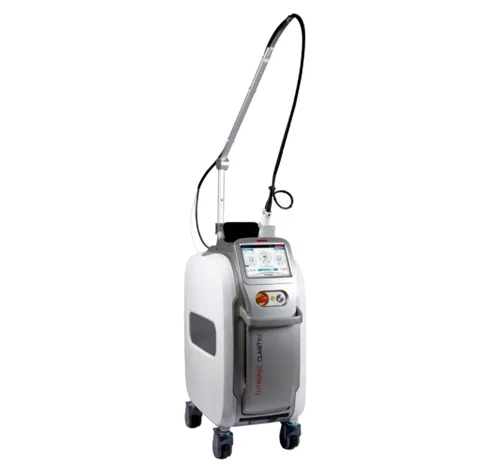
What Is The Difference Between Pico Laser And Laser Toning in Hongdae Seoul
So what is the difference between pico laser and laser toning? It is pulse duration and technique, not 2 rival machines — a pico laser fires ultra-short picosecond pulses that shatter pigment, while laser toning is a low-fluence Q-switched Nd:YAG technique using nanosecond pulses to gently fade melasma. Dr. Jae-Hong Kim matches the approach to your pigment type from ₩100,000 (about $71) in a 60-90 minute consultation, directly on the AREX line from Incheon Airport.
What Is The Difference Between Pico Laser And Laser Toning at RE:BERRY Hongdae
What is the difference between pico laser and laser toning? Pico is a pulse duration — ultra-short picosecond pulses that shatter pigment; toning is a low-fluence Q-switched Nd:YAG technique using nanosecond pulses to stabilize melasma. RE:BERRY Hongdae matches them by pigment type, graded by Dr. Jae-Hong Kim (License 138911) in a 60-90 minute consultation, from ₩100,000 (about $71) before you book.
So what is the difference between pico laser and laser toning? The honest answer is that they are not 2 rival machines — the real distinction is pulse duration and technique, and in practice they overlap. A pico (picosecond) laser fires ultra-short pulses measured in trillionths of a second, shattering pigment into finer particles largely through a photoacoustic effect that generates less heat. Laser toning is a technique, not a device: it uses a Q-switched Nd:YAG laser (typically 1064 nm) at low fluence in repeated nanosecond pulses to gradually fade melanin and calm overactive pigment cells. That conservative, stabilization-focused method is favored in Korea for managing melasma rather than aggressively removing it.
Because some picosecond platforms can also run in a toning-style low-fluence mode, the 2 approaches blur together, and the right choice depends on pigment type, skin tone and melasma tendency. Aggressive removal can backfire in melasma, so RE:BERRY Hongdae leans conservative for Fitzpatrick IV-VI skin to reduce post-inflammatory hyperpigmentation risk. Dr. Jae-Hong Kim (Korean MOHW License No. 138911) grades your pigment and matches picosecond pulses or low-fluence toning — or combines them — from the first consultation through the 4-week review, with strict sun protection built into every plan.
Pico Laser and Laser Toning Pricing at RE:BERRY Hongdae
Pico Laser and Laser Toning Before and After
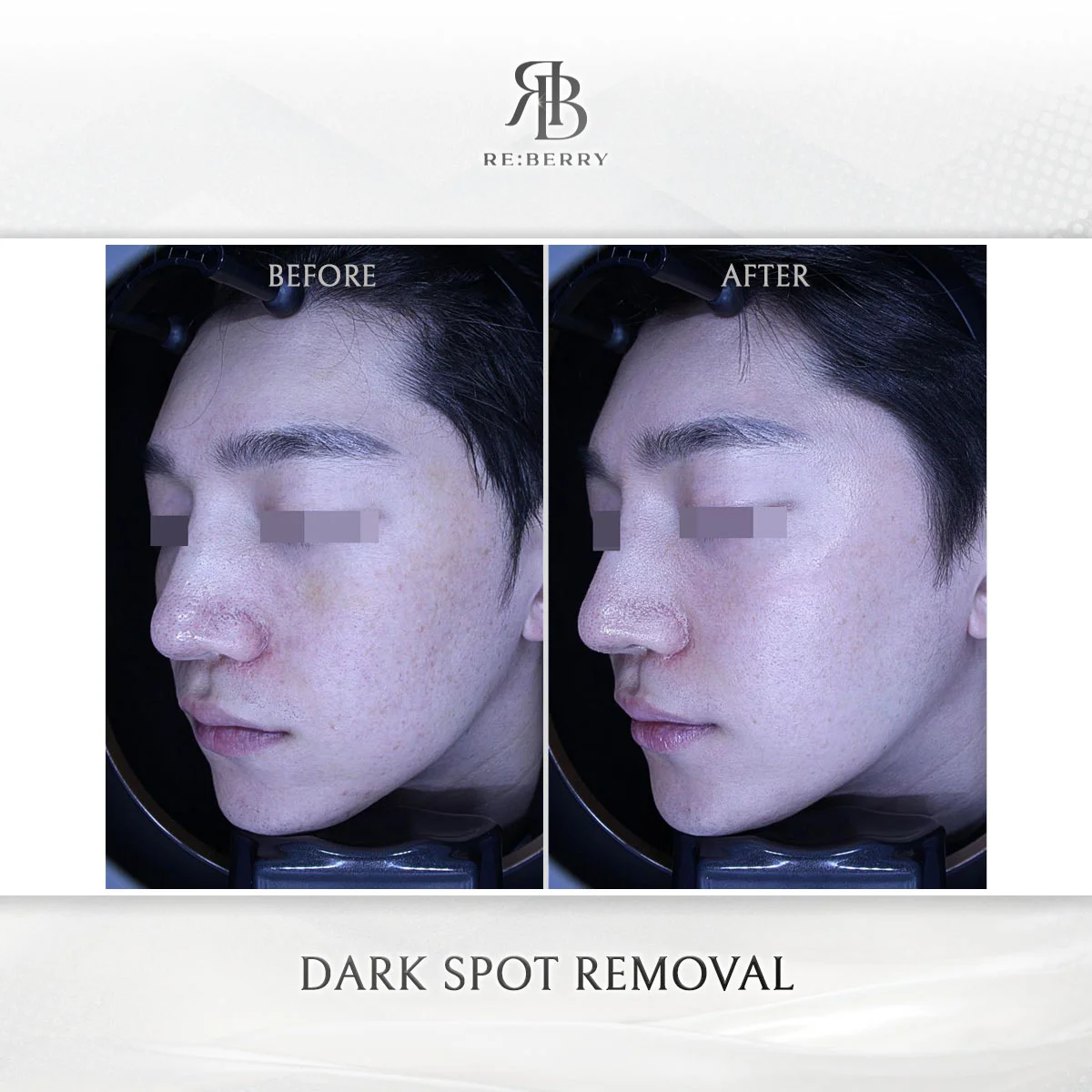
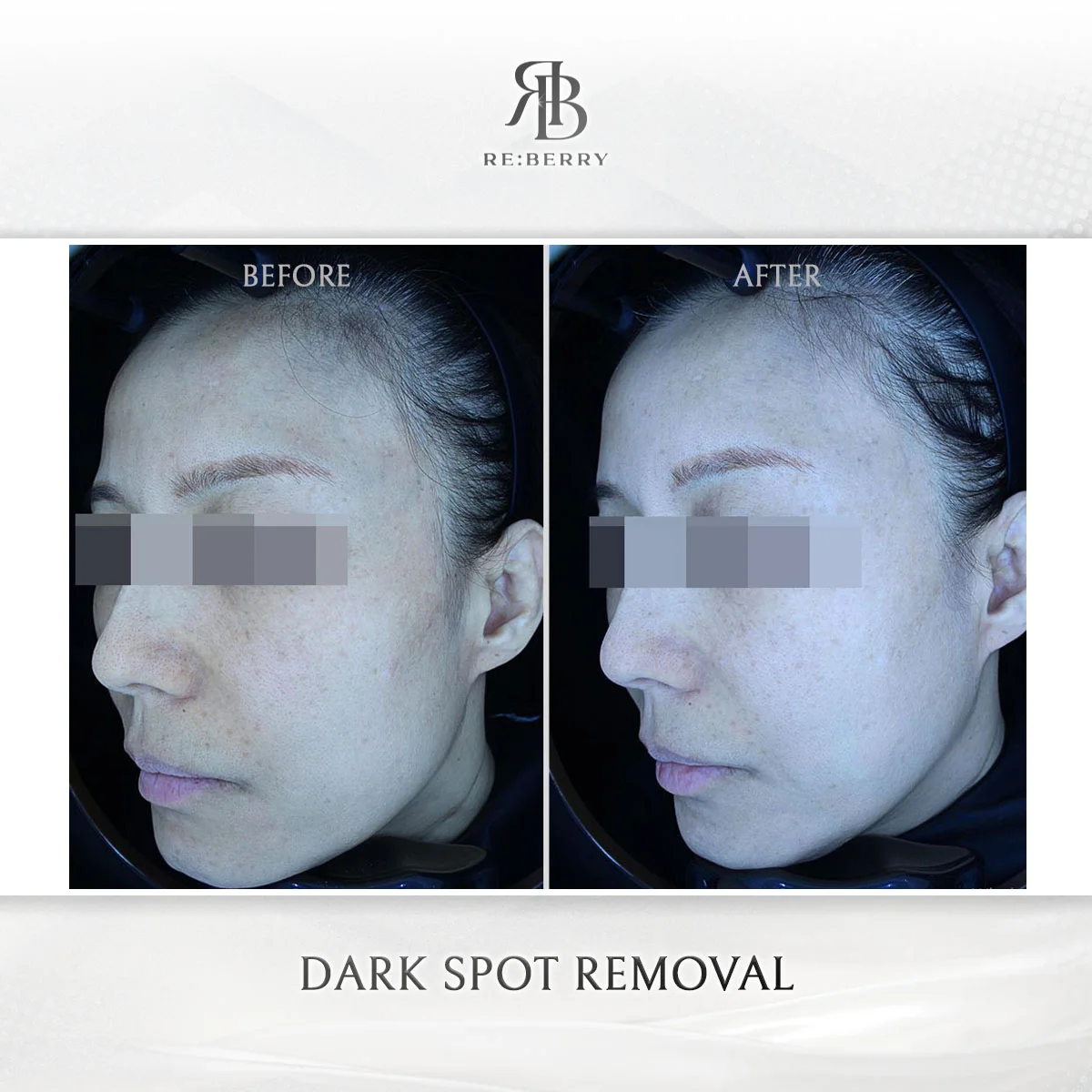
How Pico Laser and Laser Toning Work at RE:BERRY Hongdae
Step 1: Pigment Mapping and Skin Typing (15-20 min)
Over 15-20 minutes your physician grades your pigment — melasma, sun spots or post-acne marks — and records Fitzpatrick type (I-VI). Understanding what is the difference between pico laser and laser toning starts here, because Dr. Jae-Hong Kim matches picosecond photoacoustic pulses to defined pigment and low-fluence toning to melasma stabilization.
Step 2: Conservative Fluence Selection (10-15 min)
Over about 10-15 minutes the physician sets low fluence for melasma to avoid overtreatment, since aggressive settings can worsen pigment in Asian and darker skin. Toning uses repeated nanosecond pulses at low energy; picosecond mode can also be dialed conservative, so both routes are tuned to your skin type rather than a default.
Step 3: The Laser Pass (15-30 min)
A single facial session is typically short, often 15-30 minutes. A pico laser delivers ultra-short picosecond photoacoustic pulses; laser toning delivers low-fluence 1064 nm Q-switched Nd:YAG nanosecond pulses across the face. In an overlapping plan, the physician may alternate picosecond and toning passes across visits.
Step 4: Recovery and 4-Week Follow-up (10 min)
Both approaches are generally low-downtime, with only mild redness or warmth for a short time. Melasma usually needs a course of multiple sessions spaced weeks apart, so RE:BERRY Hongdae schedules a 4-week WhatsApp photo review in 8 languages and reinforces daily SPF to reduce recurrence.
Pico Laser and Laser Toning Benefits and Recovery Timeline
- Approach matched to pigment type, skin tone and melasma tendency
- Picosecond pulses shatter defined pigment photoacoustically with less heat
- Low-fluence toning stabilizes melasma gently rather than removing it aggressively
- Conservative settings chosen for Asian and darker skin to reduce PIH risk
- Both are low-downtime with only brief mild redness or warmth
- Multiple sessions spaced weeks apart with maintenance and strict sun protection
| Timeline | What to Expect |
|---|---|
| Both pico laser and laser toning are generally low-downtime, with mild redness or warmth that settles within hours to a day. Low-fluence toning is designed to be gentle, and picosecond treatment usually allows a quick return to normal activity. | |
| Pigment fades gradually over weeks. Because settings stay conservative for darker skin, the plan aims to lighten steadily while minimizing post-inflammatory hyperpigmentation, especially important in melasma. | |
| Both approaches for melasma usually require a course of multiple sessions spaced weeks apart. Published split-face trials report clinical improvement with both, sometimes faster clearance with picosecond, but results depend heavily on settings and skin type. | |
| Gradual lightening continues over weeks to months. Melasma can recur, so maintenance sessions and strict daily SPF are part of the plan rather than a one-session fix. | |
| Durable results depend on sun protection and completing the planned series. RE:BERRY Hongdae tailors intervals and technique to your pigment response through the 4-week review. |
Choosing Pico Laser versus Laser Toning in Hongdae Seoul: How RE:BERRY Compares
| Feature | RE:BERRY Hongdae | Hongik University Station Franchise Clinic | Tourist-Zone Walk-in Clinic | Source |
|---|---|---|---|---|
| Approach Framing | Matched to pigment — picosecond for defined pigment, toning for melasma stability | Often sold as one machine fits all pigment | One default setting, no pigment mapping | RE:BERRY protocol |
| Pigment Mapping | Melasma, sun spots and post-acne marks graded before choosing | Limited pigment-type assessment | Quick visual check only | RE:BERRY protocol |
| Melasma Philosophy | Conservative low-fluence stabilization, not aggressive removal | Variable, sometimes over-aggressive | Single-session upsell | RE:BERRY protocol |
| Skin-of-Color Settings | Low fluence for Asian and darker skin (lower PIH risk) | Standardized settings across patients | Fast default, limited tailoring | RE:BERRY protocol |
| Same Doctor Continuity | Same doctor from mapping to aftercare | Doctor rotation common (3-5 doctors per shift) | Walk-in assigned, no continuity guarantee | KHIDI 2025 |
| Consultation Time | 60-90 min initial assessment | 10-15 min consultation | 5-10 min walk-in assessment | OECD 2023; RE:BERRY |
| Pricing Transparency | Full quote published before you book, no add-ons | Per-session and consultation fees may be added | Extra line-item fees vary by session | RE:BERRY; public data |
Why This Matters
The core of what is the difference between pico laser and laser toning is pulse duration and technique, not 2 machines: picosecond pulses shatter pigment photoacoustically with less heat, while toning is a low-fluence Q-switched Nd:YAG nanosecond method for stabilizing melasma. RE:BERRY Hongdae matches — or combines — the 2 to your pigment type rather than defaulting to one.
Doctor continuity matters because pigment work, especially melasma, runs across a staged series needing consistent low-fluence judgment. According to KHIDI’s 2025 Medical Tourism Survey, 41.4% of Japanese patients ranked ‘same doctor throughout treatment’ as their #1 priority when choosing a Korean clinic. RE:BERRY Hongdae assigns one physician per patient for the full plan.
Korea’s average outpatient consultation is 4.3 minutes — the shortest in the OECD, whose average is 16.4 minutes. RE:BERRY Hongdae’s 60-90 minute consultations represent 15-20x the national average, giving the physician time to grade pigment and set conservative fluence safely for Asian skin. Source: KHIDI 2025; OECD Health Statistics 2023.
Your Pigmentation Laser Physician in Hongdae
Dr. Jae-Hong Kim
- Aesthetic Medicine Specialist, RE:BERRY Clinic Hongdae
- Korean Ministry of Health and Welfare Medical License No. 138911
- Regular Member, Korean Dermatological Association (kda.or.kr)
- Picosecond laser and low-fluence Q-switched Nd:YAG toning protocol lead
Medically reviewed by Dr. Jae-Hong Kim, Aesthetic Medicine Specialist, RE:BERRY
SCIENTIFIC EVIDENCE Behind Pico Laser and Laser Toning at RE:BERRY — peer-reviewed references
The peer-reviewed evidence below draws on 6 clinical studies of picosecond lasers and low-fluence Q-switched Nd:YAG toning, spanning split-face randomized trials, systematic reviews and Asian-skin cohorts. So what is the difference between pico laser and laser toning in the data? The studies map pulse duration and fluence onto pigment outcomes, including Korean clinical data in Ann Dermatol (Seoul).
Pulse Duration, Fluence and Melasma Data
A 2019 randomized split-face study directly compared a picosecond laser with a Q-switched Nd:YAG laser for facial pigmentation in Asian patients, reporting comparable improvement with a different post-inflammatory hyperpigmentation profile — evidence that the pico-versus-toning question is about pulse duration, not a single winner.
Chalermchai T, Rummaneethorn P. Picosecond vs Q-switched Nd:YAG for facial pigmentation in Asians: a randomized split-face study. Lasers Surg Med. 2019;51(8):671-678. doi:10.1002/lsm.23099
A 2020 randomized controlled trial of low-fluence 1064 nm Q-switched Nd:YAG for melasma in Asians documented gradual lightening with the conservative toning technique, supporting the stabilization-focused approach RE:BERRY Hongdae uses for melasma-prone skin.
Wattanakrai P, Mornchan R, Eimpunth S. Low-fluence Q-switched Nd:YAG 1064nm laser for melasma in Asians: a randomized controlled trial. J Cosmet Laser Ther. 2020;22(2):76-82.
A 2021 comparative analysis of post-inflammatory hyperpigmentation after picosecond versus nanosecond laser in Korean patients, published in Ann Dermatol (Seoul), quantified PIH differences that inform how RE:BERRY Hongdae chooses fluence and pulse duration for darker skin.
Kim HK, Lee SH, Kim DH, Oh SH. Comparative analysis of post-inflammatory hyperpigmentation after picosecond and nanosecond laser treatment in Korean patients. Ann Dermatol. 2021;33(4):342-349.
A 2021 systematic review of picosecond lasers in dermatology summarized evidence and recommendations across pigment indications, framing where the picosecond approach outperforms and where conservative toning remains preferable for melasma.
Wu DC, Goldman MP, Wat H, Chan HHL. A systematic review of picosecond laser in dermatology: evidence and recommendations. Lasers Surg Med. 2021;53(1):9-49. doi:10.1002/lsm.23244
A 2022 prospective Korean study in Korean J Dermatol of sequential picosecond alexandrite plus low-fluence Q-switched Nd:YAG for refractory melasma (12 weeks) supports the overlapping, combined technique RE:BERRY Hongdae uses when a single approach is not enough.
Choi YJ, Nam JH, Kim JY, Min JH, Park KY, Ko EJ, Kim BJ, Kim WS. Efficacy and safety of sequential picosecond alexandrite plus low-fluence Q-switched Nd:YAG laser for refractory melasma in Korean patients: a 12-week prospective study. Korean J Dermatol. 2022;60(4):234-241.
Wong THS, Chan HHL. Treatment of melasma by low-fluence 1064 nm Q-switched Nd:YAG laser. J Dermatolog Treat. 2014;25(2):151-155. doi:10.3109/09546634.2012.735639
These references support the RE:BERRY Hongdae pigment protocol — pigment mapping, matched picosecond photoacoustic pulses for defined pigment and low-fluence Q-switched Nd:YAG toning for melasma stability, conservative settings for Asian skin, and combined or alternating courses under the same licensed physician from first mapping through the 4-week review, with strict sun protection to reduce recurrence.
Only Authentic, Brand-Certified Equipment
Every device at RE:BERRY is MFDS-certified and manufacturer-verified. We never use counterfeit or grey-market equipment.
Brand-Authenticated Equipment & Training




Our doctors are certified by Korea’s top dermatological societies




Numbers That Tell Our Story
Real procedures performed.
What Is The Difference Between Pico Laser And Laser Toning Hongdae Seoul — Frequently Asked Questions
Pulse-duration, technique, melasma, session-count, safety and pricing answers on pico laser versus laser toning for patients in Hongdae Seoul at RE:BERRY, updated for 2026.
What is the difference between pico laser and laser toning exactly?
RE:BERRY Hongdae explains the difference is pulse duration and technique, not 2 rival machines. A pico laser fires ultra-short picosecond pulses that shatter pigment photoacoustically, while laser toning is a low-fluence Q-switched Nd:YAG technique using nanosecond pulses to gently fade melasma. They overlap, so Dr. Jae-Hong Kim matches by pigment type.
What is a pico laser and how does it work on pigment?
RE:BERRY Hongdae describes a pico laser as 1 device firing pulses in trillionths of a second, so its photoacoustic effect shatters pigment into finer particles with less heat than nanosecond lasers. That makes it strong for defined sun spots and post-acne marks, and it can also run a conservative toning-style mode.
What is laser toning and how does it work for melasma?
RE:BERRY Hongdae explains laser toning is a technique using a 1064 nm Q-switched Nd:YAG laser at low fluence in repeated nanosecond pulses to gradually fade melanin. Favored in Korea for melasma, it aims to stabilize overactive pigment cells over 6-10 sessions rather than remove pigment aggressively, which can backfire.
How much does pico laser or laser toning cost in Korea?
RE:BERRY Hongdae publishes transparent pricing for both pico laser and laser toning before you book, updated for 2026. Your WhatsApp quote covers the 60-90 minute consultation, each session and the 4-week photo follow-up as 1 all-inclusive figure, with no separate consultation charge or per-session surprises.
Is pigmentation laser cheaper in Korea than in the US or Japan?
RE:BERRY Hongdae frames value through volume and experience across 8 languages, not a discount claim. Korean clinics run notably higher pigment-laser volume than most Western markets, so Seoul physicians gain more experience matching picosecond and toning safely. Your transparent quote is published before you book, with no hidden fees.
Is pico laser or laser toning better for melasma treatment?
RE:BERRY Hongdae matches these 2 approaches to your case rather than crowning 1 winner, since picosecond pulses suit defined pigment and low-fluence toning suits melasma stability.
| Factor | Pico laser | Laser toning |
|---|---|---|
| Pulse | Picosecond | Nanosecond, low fluence |
| Best for | Defined spots | Melasma stability |
| Heat | Lower | Low, gentle |
Which is faster to clear pigment, pico laser or laser toning?
RE:BERRY Hongdae notes split-face trials sometimes show faster clearance with picosecond for defined pigment, over 4-6 sessions, while melasma toning is deliberately gradual across 8-10 sessions. Faster is not always better for melasma, since aggressive settings can rebound, so the physician tailors pace to your pigment type and skin tone.
How many pico laser or laser toning sessions do I need in Seoul?
Most RE:BERRY Hongdae melasma patients complete 6-10 toning sessions spaced weeks apart, while defined-pigment pico plans often run 4-6. Korean clinics run more of these staged pigment courses than most Western markets, so the count is tailored from higher experience rather than a fixed package sold upfront.
Which is safer for darker skin, pico laser or laser toning?
RE:BERRY Hongdae keeps both conservative for Fitzpatrick IV-VI, and 2021 Korean data show picosecond can carry a lower post-inflammatory hyperpigmentation profile than nanosecond in some cases. Korean clinics carry higher pigment-laser volume across darker skin than most Western markets, so RE:BERRY physicians bring more experience keeping settings safe.
Does laser toning use a Q-switched Nd:YAG laser?
Yes — RE:BERRY Hongdae confirms laser toning uses a 1064 nm Q-switched Nd:YAG laser at low fluence, delivering repeated nanosecond pulses. It is a technique built on that device, whereas pico refers to the picosecond pulse width; some picosecond platforms can also run a toning-style low-fluence mode in the same 60-90 minute plan.
Can pico laser and laser toning be combined for pigment?
Yes — RE:BERRY Hongdae often combines the 2, and a 2022 Korean study of sequential picosecond plus low-fluence toning supports it for refractory melasma. The physician may alternate picosecond passes for defined spots with conservative toning for melasma across visits, tuning both to your pigment type rather than picking 1 approach.
Is there downtime after pico laser or laser toning in Seoul?
RE:BERRY Hongdae reports both of the 2 approaches are generally low-downtime, with only mild redness or warmth for a short time after each session. Low-fluence toning is designed to be gentle and picosecond usually allows a quick return to normal activity, which the physician confirms during your 60-90 minute consultation. See other options.
Where can I get pico laser or laser toning near Hongdae in Seoul?
RE:BERRY Hongdae sits in Mapo-gu near Hongik University Station, 1 no-transfer AREX ride from Incheon Airport T1/T2. Compared with most Western clinics, Seoul’s Hongdae district offers higher pigment-laser volume and 8-language support, so international patients get more experienced pico and toning care close to the airport line.
Who performs pico laser and laser toning at RE:BERRY Hongdae?
100% of pigment-laser care at RE:BERRY Hongdae is performed by Dr. Jae-Hong Kim (Korean MOHW License No. 138911) — no rotating staff. Korean physicians handle higher energy-device volume than most Western markets, so you benefit from more experience across your other plans too.
What makes pico laser and laser toning at RE:BERRY Hongdae different?
3 things set RE:BERRY Hongdae apart: pigment-to-technique matching instead of 1 default machine, a conservative melasma-stability philosophy, and transparent pricing published before you book. The clinic also sits in Hongdae’s design district — see the ultherapy prime page for the same standard.
Book Your Pico Laser and Laser Toning Consultation at RE:BERRY Hongdae
Still weighing what is the difference between pico laser and laser toning for your pigment? Get a mapped plan — picosecond photoacoustic pulses for defined spots, low-fluence Q-switched Nd:YAG toning for melasma stability — with transparent pricing from ₩100,000 (about $71), published before you book. Directly on the AREX line from Incheon Airport, 1 train ride to Hongik University Station. Dr. Jae-Hong Kim handles your plan from mapping through 4-week aftercare. This information is for educational purposes only and is not medical advice; consult a licensed physician for individual guidance. Your plan is confirmed in writing before you book.
Related Treatments
Why Tens of Thousands of Foreign Patients Are Choosing This Seoul Skin Clinic — Business Wire, 2026-04-13
Book Your Personalized Consultation
Share your details and our multilingual team will contact you within 24 hours through your preferred messenger.
- ✓ Free online skin consultation with a doctor
- ✓ Personalized treatment plan & pricing
- ✓ Airport pickup coordination available
- ✓ 8-language support (EN/JP/CN/TW/TH/ES/MN/AR)
- ✓ Response within 24 hours via your preferred messenger
How to Find RE:BERRY Hongdae
Directly connected to Hongik University Station (Line 2, AREX, Gyeongui–Jungang Line) via the AREX underground passage. 3F & B2, 140 Yanghwa-ro, Mapo-gu, Seoul.
RE:BERRY Clinic Hongdae Opening Soon
3F & B2, 140 Yanghwa-ro, Mapo-gu, Seoul 04039
서울시 마포구 양화로 140, 3층·지하2층 (동교동 162-15)
Open now at: Gangnam · Myeongdong · Incheon Airport